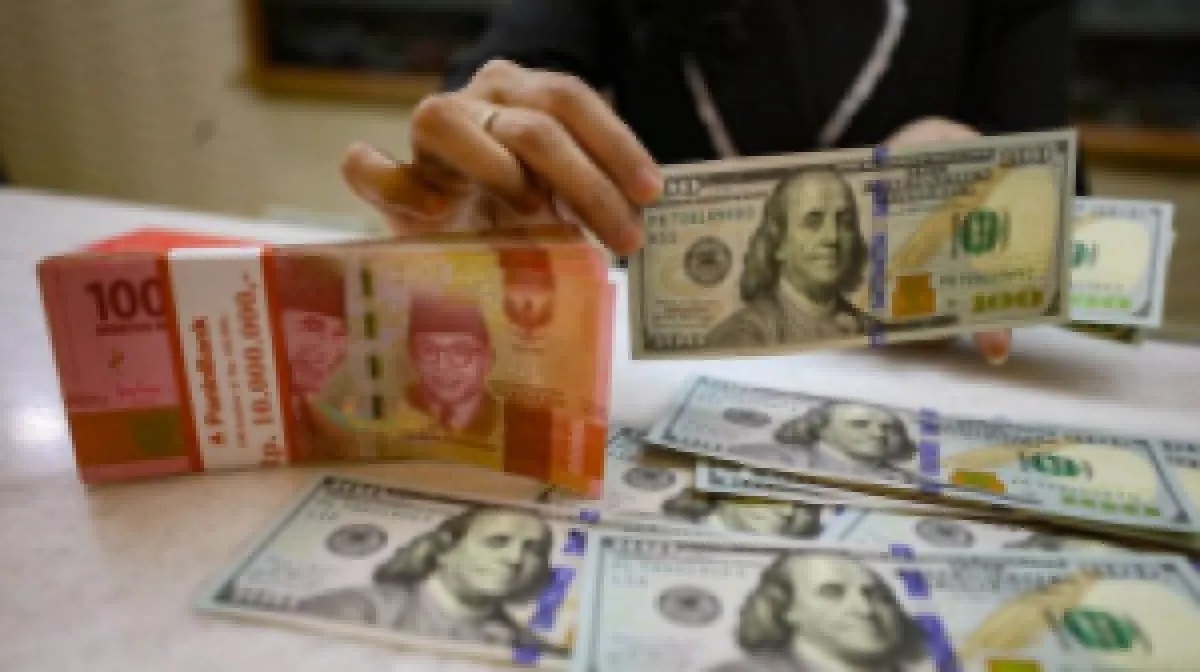
New York: The US Dollar (USD) saw another minor drop on Tuesday, June 16, 2026, which has now seen it weaken four days straight, stemming from the increasing likelihood for a US-Iran peace deal.
Meanwhile, the foreign exchange market oversaw Japan and Australia’s interest rate hikes a day before the results of the Federal Reserve’s first monetary policy committee, under the new leadership of Chairman Kevin Warsh.
According to Investing.com’s US Dollar index – which tracks the value of the US Dollar against six other major currencies – the USD fell 0.1 percent to 99.56 on Wednesday, June 17, 2026. US-Iran Peace Deal to Be Signed on Friday Washington and Tehran are scheduled to meet on Friday for the signing of the Memorandum of Understanding (MoU) between the two parties. US President Donald Trump gloated that the Straight of Hormuz, which has been effectively closed since the start of the conflict in late February, will be “fully opened” on Friday, the 19th.
Trump further vowed to reveal the contents of the MoU on Friday. Following his arrival, the US president stated that the second phase of negotiations would begin, and last for approximately 60 days.
“Iran wants to get it done. They have to get back to business, and the relationship is now normalized, so I think it’s going to go pretty quickly,” said Trump.
Trump added that the MoU served as a "very important document that was a against Iran’s acquirement of nuclear weapons. The MoU is also said to include the removal of the ongoing American naval blockade of Iran ports and coastline.
Other details about the agreement remain vague, with several conflicting claims in regard to its contents. Despite Trump’s claims that the deal would reaffirm Iran’s commitment to the non- proliferation treaty (NPT) of nuclear weapons, Iranian state media has reported otherwise, describing the discussions as general; at this stage, and that Iran had not entered into negotiations on the nuclear issue.
Media reports also stated that the agreement includes plans for a $300 billion private fund aimed at fueling investment in Iran, with the fund separate from negotiations over frozen Iranian assets. But Trump has since declared it as fake news. Focus on Fed and BoJ Rate Hike A day before the Feds interest rate decision, oil prices have dropped to their lowest levels in more than three months. The Federal Open Market Committee (FOMC) is widely expected to keep interest rates unchanged coming into Wednesday, with officials continuing to monitor rising inflationary pressures, caused largely by a spike in US-Iran conflict related fuel costs.
Consequently, much of the focus will be on the Fed latest economic projections, alongside post-decision comments from new Chairman Kevin Warsh. However, the recent drop in oil prices has given the central bank some breathing room amidst policy tightening.
Elsewhere, the Central Bank of Japan (BoJ) raised its short-term policy interest rate by 25 basis points to 1.0 percent, the nation’s highest level in 31 years, in a widely anticipated move aimed at containing inflation and continuing the gradual normalization of monetary policy.
This decision comes at a time when Japan continues to struggle with a weakening yen. The USD/JPY pair was last up 0.1 percent to 160.47, above the key 160 level that had prompted intervention from Tokyo.
One possible impact of falling oil prices is a decline in USD/JPY. Obviously, the Central Bank of Japan (BoJ) is likely to continue raising its policy interest rates, motivated by higher growth, higher inflation, and a weak JPY. But if crude oil prices continue to decline, the fundamental motivation to buy USD/JPY will disappear, and any intervention from the Ministry of Finance
and the BoJ will gain credibility.
We think that the structural decline in USD/JPY may continue, slowly, taking the pair towards 153 by the end year,” said the global foreign exchange and
Macquarie interest rate strategist, Thierry Wizman.
On a separate note, the risk-prone Australian dollar fell 0.1 percent against the USD to a rate of 0.7066 per, after the Reserve Bank of Australia ended a three-month tightening trend, leaving its benchmark interest rate at 4.35 percent.
The Sterling saw a minor shift ahead of the Bank of England’s (BoE) decision on Thursday. Meanwhile, the European Central Bank has moved to counter the post-war price pressures with an interest rate hike last week, with the Bank of England (BoE) expected to maintain its current policy.
Hampered by weakening growth and a constricting national budget, the BoE lacks the economic support to keep up with the interest rate hikes of other nations. With parliamentary by-elections looming, the BoEs dovish policy on Thursday could see the bank swiftly remove its interest rate support for the pound, leaving it vulnerable to stagflation.
(Jonathan Sianto)
US Dollar Weakens Ahead of Fed Interest Rate Decisions